

What Is Search Visibility?
Understanding Your Visibility Score
and How to Improve It
Search visibility refers to how prominent your website is in organic search results across the keywords that matter to your business. It’s the big-picture answer to a simple question: when people search for topics you should be showing up for, do they actually see you?
Individual keyword rankings can’t answer that question on their own. You might rank third for one term and thirtieth for another, but without understanding the search volume behind each term and how likely people are to click at each position, those numbers don’t tell you much about your actual organic presence. Search visibility fills that gap by combining ranking positions and search demand into a single perspective on how much of the organic opportunity you’re capturing.
This guide covers what search visibility means, how SEO tools turn it into a visibility score, what causes it to move, and how to improve yours over time.
Table of Contents
Why Search Visibility Matters More Than Rankings Alone
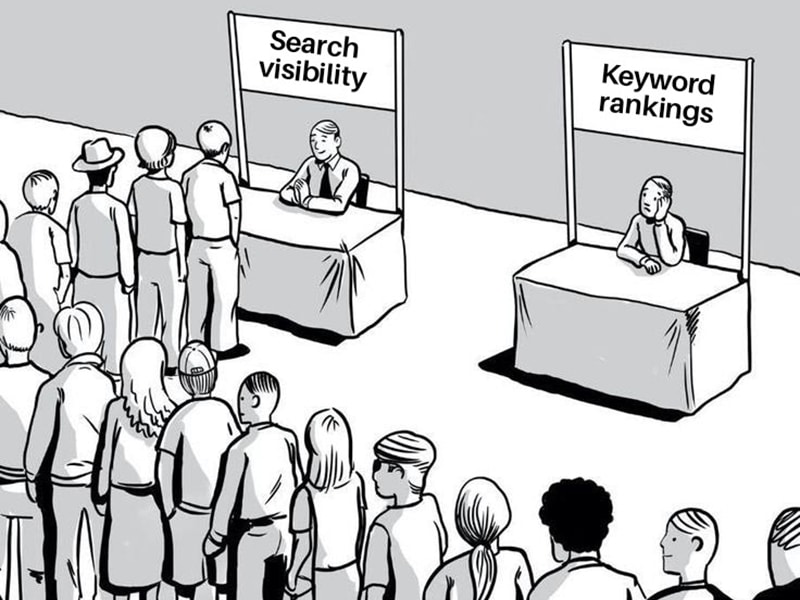
Rankings tell you your position. Search visibility tells you the impact. The difference between those two things is worth understanding clearly.
Rankings without context are misleading
A #1 ranking for a keyword that gets 10 searches per month contributes almost nothing to your organic presence. A #5 ranking for a keyword that gets 50,000 monthly searches contributes far more. If you report to a client or stakeholder that you “rank on page one for 40 keywords,” that sounds impressive, but it says nothing about whether those keywords drive meaningful traffic or whether your site is actually visible where it counts.
Search visibility solves this by weighting each ranking according to the search volume behind it and the click-through rate associated with that position. It shifts the conversation from “where do we rank?” to “how much of the available organic attention are we actually capturing?”
The click-through rate curve changes everything
The relationship between ranking position and clicks is not linear — it’s exponential at the top and nearly flat everywhere else. Studies consistently show that the top three organic results capture between 50% and 70% of all clicks on a given results page. By position five, click-through rates drop to around 5-7%. By position ten, they fall below 3%.
This means that moving from position 5 to position 2 for a single keyword can produce a larger increase in organic traffic than moving 20 keywords from page three to page two. Search visibility accounts for this reality. Raw ranking counts don’t.
Visibility connects SEO to business outcomes
Traffic alone doesn’t tell you whether your SEO strategy is working. You could see traffic increase because of a few seasonal keywords while your core terms are quietly slipping. Search visibility, tracked consistently, reveals whether your organic presence is growing, shrinking, or stagnating across the keyword landscape that actually matters to your business.
When leadership asks “how is SEO going?”, it’s the search visibility score that gives you a more honest, defensible answer than cherry-picked ranking improvements or raw traffic numbers that fluctuate for reasons unrelated to your work.
What Is a Visibility Score?
Search visibility is the concept. A visibility score is how SEO tools quantify it. A visibility score is a percentage-based metric that represents how much of the available organic search traffic your website captures for a set of tracked keywords. It’s the number you see in platforms like Semrush, Ahrefs, and AgencyAnalytics that distills all your keyword rankings into a single, trackable figure.
The score itself is straightforward to read: higher is better. But the way it’s calculated, what it actually represents, and how to use it properly are less obvious. Most site owners check their visibility score without understanding why it moves, why it differs between tools, or how to set up tracking in a way that produces actionable numbers rather than vanity metrics.
How Visibility Scores Are Calculated

Every major SEO platform calculates visibility scores using the same two inputs (ranking position and search volume) but the specific formulas differ enough that scores from different tools are not directly comparable.
The core logic
The general approach works like this: for each tracked keyword where your site ranks within the top results (usually top 20 or 30), the tool assigns a weight based on your ranking position. That weight is then multiplied by the keyword’s monthly search volume. The individual keyword contributions are aggregated into an overall percentage.
Position weighting reflects real-world click behavior. A #1 ranking receives maximum weight (close to 1.0) because that position captures the highest click-through rate. Positions further down the page receive progressively lower weights, with positions beyond 20 often weighted at 0.05 or less. The weighting curve is steep at the top: the difference between position 1 and position 5 is much larger than the difference between position 15 and position 20.
How Semrush calculates it
Semrush calculates what it calls “Estimated Traffic %” by using expected click-through rates derived from its proprietary dataset. Each tracked keyword’s ranking is assigned a CTR estimate, and that CTR is multiplied by the keyword’s search volume to produce an estimated traffic figure. The sum of these figures, expressed as a percentage of total possible traffic across all tracked keywords, becomes your visibility score.
Semrush updates these scores daily for tracked keyword sets and provides both desktop and mobile breakdowns. The tool also factors in SERP features to some extent — if a featured snippet sits above position one, the CTR estimates for standard organic results are adjusted downward.
How Ahrefs calculates it
Ahrefs takes a click-share approach. Rather than using position-based CTR estimates, it pulls estimated total clicks on search results for each tracked keyword and calculates what percentage of those clicks go to your site. This means Ahrefs accounts for queries where users click multiple results or no results at all, producing a score that more closely reflects actual click distribution.
Because Ahrefs uses click data rather than position-based CTR curves, its scores tend to look different from Semrush scores for the same website — even when the underlying rankings are identical. Neither is wrong; they’re measuring slightly different things.
How AgencyAnalytics calculates it
AgencyAnalytics uses a weighted-volume formula: each ranking position is assigned a fixed visibility weight (e.g., position 1 = 1.0, position 2 = 0.9, and so on down), and that weight is multiplied by the keyword’s search volume. The sum is then divided by the total search volume across all tracked keywords to produce a percentage.
This approach is more transparent and predictable than the CTR-based models used by Semrush and Ahrefs, which makes it easier to understand why your score changed on a given day. The trade-off is that it doesn’t account for real-world click behavior as granularly.
Why your scores won’t match across tools
Beyond formula differences, each tool maintains its own keyword database with its own search volume estimates. A keyword that Semrush estimates at 5,000 monthly searches might show as 3,800 in Ahrefs. Those volume differences ripple through the visibility calculation and change the final score.
Some tools factor in SERP features. Others treat every results page as a standard list. Desktop and mobile results can produce different scores because rankings sometimes vary between devices. The practical rule is simple: pick one tool, track everything within it, and never compare your Ahrefs score against a competitor’s Semrush score.
Setting Up Visibility Score Tracking

A visibility score is only as useful as the keyword set behind it. Sloppy keyword selection produces scores that look good on a dashboard but don’t connect to actual business performance.
Building your keyword set
Start with the keywords that represent your core business — the terms that, if you ranked well for them, would drive qualified traffic and revenue. Then expand outward to include related terms, question-based queries, and long-tail variations that your target audience uses.
A well-structured keyword set includes:
- Branded terms. Your company name, product names, and branded phrases. These establish a baseline since you should rank well for them.
- Non-branded head terms. High-volume keywords that describe your products, services, or content areas. These drive the bulk of your visibility score.
- Long-tail keywords. More specific phrases with clearer intent but lower volume. These won’t move your overall score much individually, but they indicate whether your content depth is working.
- Competitor overlap terms. Keywords your competitors rank for that you don’t yet. Including these shows your gap and gives your score room to grow as you expand.
Segmenting keywords by group
Tracking a single aggregate score across hundreds of keywords hides useful detail. Most tools let you group keywords by topic, product line, funnel stage, or content type. Use this.
When your overall score drops by 3%, the first question should be “where?” If the drop is concentrated in one keyword group (say, your product comparison terms) that points to a specific problem you can investigate. If it’s spread evenly across all groups, you’re looking at something broader like a technical issue or algorithm update.
Typical segmentation approaches:
- By topic or category – Group keywords by the subject area they relate to (e.g., “email marketing,” “social media,” “SEO”)
- By funnel stage – Separate awareness-stage informational keywords from consideration-stage comparison keywords and decision-stage transactional keywords
- By product or service line – Useful for businesses with multiple offerings that have distinct audiences
- By page type – Blog posts vs. landing pages vs. product pages, to see which content format is gaining or losing search visibility
Choosing your tracking frequency
Daily tracking is available in most tools but rarely necessary for visibility scores. The metric is designed to smooth out the noise of individual ranking fluctuations, so checking it daily often creates anxiety over movements that are meaningless.
Weekly monitoring strikes the right balance for most sites. It catches algorithm updates, competitive shifts, and technical problems without drowning you in noise. Set a consistent day (Monday morning works well) and review the trend alongside any site changes or known Google updates from the previous week.
During active SEO campaigns, after a site migration, or following a major algorithm update, checking every few days is reasonable. Outside those situations, weekly is enough.
Maintaining your keyword list over time
A keyword set that never changes becomes less accurate over time. New products launch. Customer language shifts. Seasonal terms become relevant. Competitors enter new areas.
Review your keyword list quarterly. Add terms you’ve discovered through keyword research, search console data, competitor analysis, or new content you’ve published. Remove terms that are no longer relevant to your business. Adjust groupings as your content strategy evolves. Each time you change the keyword list, note it, because changes to the tracked set will change the score independent of any actual ranking movement, and you want to distinguish between “our visibility improved” and “we added keywords we already rank well for.”
Reading and Interpreting Your Visibility Score

The number itself is less important than what you do with it. Misinterpreting visibility changes leads to wasted effort or, worse, unnecessary panic.
Your score vs. competitor scores
A visibility score in isolation tells you very little. Is 25% good? It depends entirely on your market. If your three closest competitors sit at 18%, 15%, and 10%, then 25% is dominant. If the market leader sits at 60%, then 25% means you have significant ground to cover.
Most SEO tools let you track competitor visibility alongside your own within the same keyword set. This is the single most valuable way to use the metric. When your score rises but a competitor’s rises faster, you’re losing relative ground even though the trend looks positive. When your score dips but every competitor also dips, you’re likely looking at an algorithm update or SERP feature change rather than a problem specific to your site.
Identifying score-moving keywords
When your overall score changes, a handful of keywords usually account for most of the movement. High-volume keywords have an outsized impact on the aggregate number. If you rank for a keyword with 50,000 monthly searches and your position changes from 3 to 7, that single keyword can pull your entire score down by several percentage points (even if all your other rankings are stable).
Drill into the keyword-level data whenever you see a meaningful change. Most tools show which keywords gained or lost positions during a given period. Sorting by the impact on your visibility score (rather than by position change) reveals which keywords actually drove the shift.
Distinguishing real changes from noise
Search results fluctuate constantly. Google tests different rankings, refreshes its index, and adjusts features. A visibility score that moves one or two percentage points from one week to the next is normal background noise, not a signal to act on.
Watch for these patterns instead:
- Sustained decline over 3+ weeks. A real problem that needs investigation. Check for technical issues, lost backlinks, and recent algorithm updates.
- Sharp single-week drop. Often caused by a Google algorithm update or a technical issue like a robots.txt misconfiguration or an indexing problem. Check Google Search Console for crawl and indexing alerts.
- Gradual upward trend. Your SEO efforts are working. Continue the current approach and document what’s driving the gains.
- Flat score despite active SEO work. Your improvements may be offset by competitor gains or by targeting keywords where the score impact is minimal. Revisit your keyword prioritization and technical SEO fundamentals.
Accounting for SERP feature impact
A visibility score calculated purely on ranking position can overestimate your real exposure when SERP features are present. Your site might rank second for a given keyword, but if a featured snippet, an AI Overview, and a People Also Ask box sit above you, your actual click share is significantly lower than a standard position-two CTR would suggest.
Some tools adjust for this. Others don’t. Know which approach your tool uses, and factor it into your interpretation. If you notice your visibility score is stable but your actual organic traffic from Search Console is declining, SERP feature expansion is a likely cause.
Benchmarking and Reporting

Visibility scores become most useful when they’re communicated clearly and compared against meaningful reference points.
Setting realistic targets
Reaching 100% visibility is not realistic. Competitors, paid ads, and SERP features all absorb portions of available clicks. A more practical approach is to set targets based on your current position relative to competitors.
If your top competitor’s visibility score is 35% and yours is 15%, a reasonable near-term target might be reaching 20-22%. That represents measurable progress without requiring an unrealistic jump. As you close the gap, each additional percentage point typically becomes harder to gain because you’re now competing for positions at the top of results where competition is fiercest.
Reporting to stakeholders
Agencies that provide organic SEO services are responsible for presenting visibility scores to clients or leadership, and in those situations – context is everything. A standalone number (“our visibility score is 28%“) means nothing without reference points. Always present it alongside:
- Competitor scores – Where you stand relative to the market.
- Historical trend – The direction of travel over the past 3-6 months.
- Keyword group breakdown – Which areas are strong and which need work.
- Notable events – Algorithm updates, site changes, or competitor movements that explain any unusual shifts.
Avoid mixing scores from different tools in the same report. If you’ve used Semrush throughout and need to switch to Ahrefs, note the transition clearly and re-baseline all historical comparisons.
Common reporting mistakes
- Comparing scores across different tools. A 30% Semrush score and a 30% Ahrefs score do not mean the same thing.
- Reacting to single-week changes. One data point is not a trend.
- Ignoring keyword set changes. Adding or removing keywords changes the score independent of ranking movement.
- Presenting the score without competitor context. A rising score in a market where competitors are rising faster is not actually good news.
What Causes Search Visibility to Change
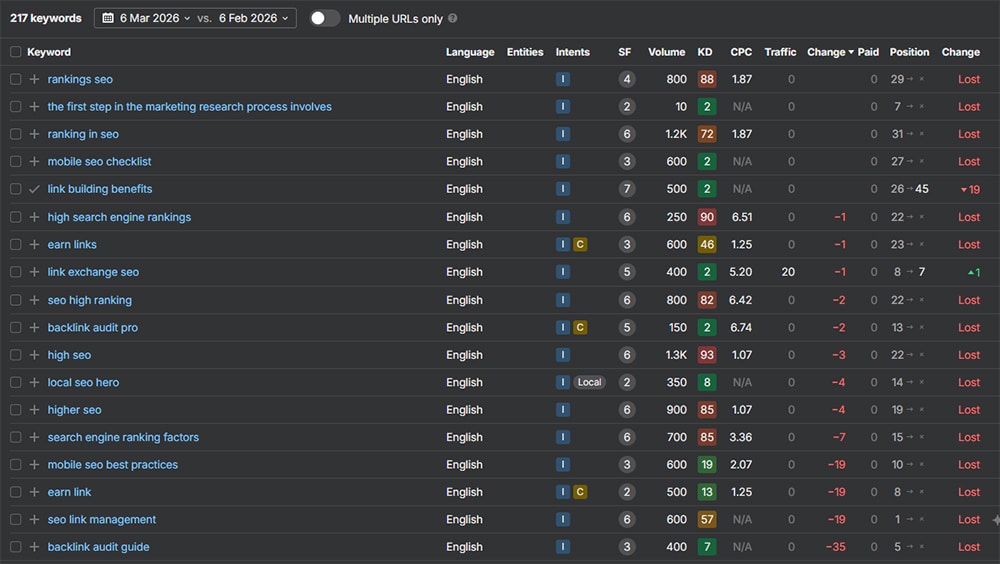
Visibility doesn’t move randomly. Specific, identifiable factors push it up or pull it down, and understanding them helps you respond effectively.
Algorithm updates
Google runs thousands of algorithm changes per year, but the major core updates (typically a few per year) are the ones most likely to produce noticeable visibility shifts. These updates often adjust how Google evaluates content quality, relevance, and authority. A core update might reward sites with stronger topical depth and penalize thin content, causing visibility to shift across entire industries.
When your visibility drops after a confirmed update, resist the urge to make immediate, sweeping changes. Monitor for two to three weeks to see whether the drop stabilizes or reverses. Google’s own guidance is that there may not be anything specific to “fix” — the algorithm is simply recalibrating which content best serves searchers.
Competitor activity
Your search visibility is relative. When a competitor publishes stronger content, earns authoritative backlinks, or restructures their site for better topical coverage, they can displace your rankings without you doing anything wrong. This is especially common in competitive niches where multiple sites are actively investing in SEO.
Tracking competitor visibility alongside your own (which most SEO platforms support) helps you distinguish between “we’re doing something wrong” and “a competitor just got better.” Those two situations require very different responses.
Technical issues
Crawl errors, indexing problems, slow page speed, broken redirects, and mobile usability issues can all silently erode visibility. These problems are particularly damaging because they often don’t produce obvious symptoms until the damage accumulates. A page that Google can’t crawl won’t rank. A page that loads slowly will gradually lose position to faster alternatives.
Regular technical audits catch these issues before they compound. Prioritize anything that affects crawlability and indexation first, since a page that isn’t indexed has zero visibility regardless of how good the content is.
SERP feature changes
Search results pages are no longer just ten blue links. Featured snippets, AI Overviews, People Also Ask boxes, image packs, video carousels, and knowledge panels now occupy significant space above traditional organic listings. When Google introduces or expands a SERP feature for keywords you rank for, your organic visibility can decrease even if your ranking position stays the same — because less attention reaches the standard organic results.
This trend is accelerating. Monitoring which SERP features appear for your target keywords helps you understand whether a visibility drop is caused by your own performance or by changes in how Google presents results.
Content decay
Content that performed well a year ago may not perform well today. Information becomes outdated. Competitors publish newer, more comprehensive alternatives. User expectations evolve. This gradual decline, often called content decay, is one of the most common and least dramatic causes of visibility loss. It doesn’t happen overnight, so it’s easy to miss until the cumulative effect becomes significant.
Auditing your top-performing content on a regular cycle and refreshing it with current information, better structure, and expanded coverage is one of the most reliable ways to defend existing visibility.
How to Improve Your Search Visibility

Improving search visibility means ranking higher for more valuable keywords. That requires coordinated work across content, technical health, and authority, not just one of those in isolation.
1. Prioritize striking distance keywords
The highest-return visibility improvements come from keywords that already rank near the top of results. A keyword at position 8 that moves to position 3 will produce a much larger visibility gain than ten keywords moving from position 40 to position 30. The click-through rate curve makes this math unavoidable.
Filter your tracked keywords to find terms ranking between positions 4 and 15. These “striking distance” keywords are your best candidates for focused optimization because Google already considers your content relevant — it just needs to be pushed higher. Prioritize the ones with the highest search volume, since those move overall visibility the most.
2. Align content with search intent
Search intent alignment is the single biggest factor in whether a page can rank in the top positions. If the top results for a keyword are all long-form comparison guides and your page is a product listing, you’re fighting against what both searchers and Google expect.
For each target keyword, study the top three to five results and pay attention to:
- Format. Is it a blog post, a comparison page, a tool, or a video?
- Depth. How detailed is the content? What subtopics does it cover?
- Angle. What specific perspective or promise does the title make?
Then structure your content to match or exceed that standard. When you see a page stuck on page two despite strong on-page SEO, intent misalignment is often the reason. Rewriting content to match what searchers actually want frequently produces ranking improvements without building a single new link.
3. Build topical authority
Google increasingly evaluates sites based on their depth of coverage across a topic, not just the strength of individual pages. A site that publishes one article about project management will struggle to outrank a site that has 30 interlinked articles covering every aspect of the subject.
Building topical authority means systematically covering the subtopics, questions, and related concepts within your core areas. This creates a content ecosystem where each page supports the others through internal links and shared relevance signals. Over time, this approach makes it easier for every new page you publish within that topic to rank because Google already trusts your site as an authority on the subject.
4. Earn relevant backlinks
External backlinks remain one of the strongest ranking factors. Each link from a relevant, authoritative website acts as a vote of confidence that signals to search engines your content is worth ranking. The emphasis should be on relevance — a link from a topically related site carries more weight than one from a generic domain with no connection to your subject matter.
The Skyscraper method is one proven approach: find competing content that has attracted backlinks, create something meaningfully better, and reach out to the sites that linked to the original. The pitch is straightforward: you’ve built a more current, more useful resource, and linking to it serves their audience better.
5. Strengthen internal linking
Internal linking is entirely within your control and often underused. When you link from a high-authority page to a newer or weaker page, you direct ranking power where it’s needed most. A well-planned internal linking structure distributes authority across your site and helps search engines understand which pages matter most.
Audit your internal links periodically. Look for high-authority pages that aren’t linking out to related content, and for newer pages that have few or no internal links pointing to them. Fixing these gaps is one of the fastest ways to improve visibility for underperforming pages.
6. Optimize for SERP Features
Featured snippets, image packs, AI Overviews, and knowledge panels occupy large portions of the visible results area. Winning one of these placements can increase your search visibility even without holding a traditional #1 organic ranking.
Structure your content with clear headings, concise answer paragraphs, and structured data markup to qualify for these placements. Featured snippets tend to pull from pages that present information in easily extractable formats — short paragraphs that directly answer a question, bulleted lists, or comparison tables. Monitor which SERP features appear for your target keywords and adapt your content format accordingly.
Having a Clear Picture
Search visibility gives you something that individual keyword rankings can’t — a clear, weighted picture of how much of the organic search opportunity you’re actually capturing. It connects SEO performance to business outcomes in a way that raw rankings and traffic numbers on their own do not. And the visibility score on your dashboard is a starting point, not an answer — it’s only useful when it’s calculated consistently, tracked against a meaningful keyword set, and interpreted alongside competitor performance and market context.
The sites that track their visibility consistently, understand what causes it to shift, and focus their optimization on the highest-impact opportunities are the ones that build durable organic presence over time. Rankings fluctuate. Algorithms change. But a deliberate, informed approach to search visibility compounds in your favor.
Frequently Asked Questions (FAQ)
1. What is search visibility in SEO?
Search visibility describes how prominent your website is in organic search results across a set of keywords. It accounts for both your ranking positions and the search volume behind those keywords, giving you a more complete picture of your organic presence than individual rankings can provide.
2. What is a visibility score, and how is it different from search visibility?
Search visibility is the concept — how prominently your site appears in organic results overall. A visibility score is the number SEO tools use to quantify that concept: a percentage-based metric calculated from your ranking positions, the search volume of each tracked keyword, and the expected click-through rates at each position. One is the idea, the other is the measurement.
3. Why is search visibility more useful than tracking rankings?
Rankings tell you position but not impact. A #1 ranking for a keyword with 10 monthly searches contributes almost nothing to your organic presence, while a #5 ranking for a keyword with 50,000 searches contributes substantially. Search visibility weights rankings by volume and click-through rates, so it reflects actual organic reach.
4. Why is my visibility score different in Semrush vs. Ahrefs?
Each tool uses a different calculation method. Semrush uses position-based CTR estimates, while Ahrefs uses click-share data. They also maintain separate keyword databases with different search volume estimates. These differences produce different scores for the same website. Neither is incorrect — they’re measuring slightly different aspects of the same concept.
5. What causes search visibility to drop?
Common causes include Google algorithm updates, increased competition, technical issues like crawl errors or slow page speed, changes in SERP features that push organic results further down the page, and content decay — where previously strong content becomes outdated relative to newer competitor pages. A visibility score can also drop without any rankings actually being lost: if new SERP features absorb clicks that used to go to organic results, or if search volumes for your tracked keywords shift, the score moves even when your positions hold.
6. What is a good visibility score, and is 100% possible?
It’s 100% not realistic. Competitors, paid ads, and SERP features all absorb portions of the available clicks, so even the most dominant site in a niche shares organic attention with other results. As a rough guide, above 50% is strong in most markets and below 30% usually indicates room for growth, but the most useful benchmark is your score relative to direct competitors within the same tool. A 20% score that leads your competitive set is better than a 40% score that trails behind.
7. How do I improve search visibility quickly?
The fastest gains come from optimizing “striking distance” keywords — terms where you rank between positions 4 and 15. These already have Google’s recognition as relevant, and moving them higher produces outsized visibility gains due to the steep click-through rate curve at the top of results.
8. How many keywords should I track for an accurate visibility score?
There’s no fixed number, but the set should be large enough to represent your organic opportunity and varied enough to include both head terms and long-tail keywords. For most businesses, 50-200 tracked keywords across core topics provides a meaningful score. Very large sites might track 500+. The key is that the set reflects what your audience actually searches for, not just terms where you already rank well.
