
What is Search Visibility and Why It Matters For SEO?
Search visibility refers to how prominent your website is in organic search results across the keywords that matter to your business. It’s the big-picture answer to a simple question: when people search for topics you should be showing up for, do they actually see you?
Individual keyword rankings can’t answer that question on their own. You might rank third for one term and thirtieth for another, but without understanding the search volume behind each term and how likely people are to click at each position, those numbers don’t tell you much about your actual organic presence. Search visibility fills that gap by combining ranking positions and search demand into a single perspective on how much of the organic opportunity you’re capturing.
Why Search Visibility Matters More Than Rankings Alone
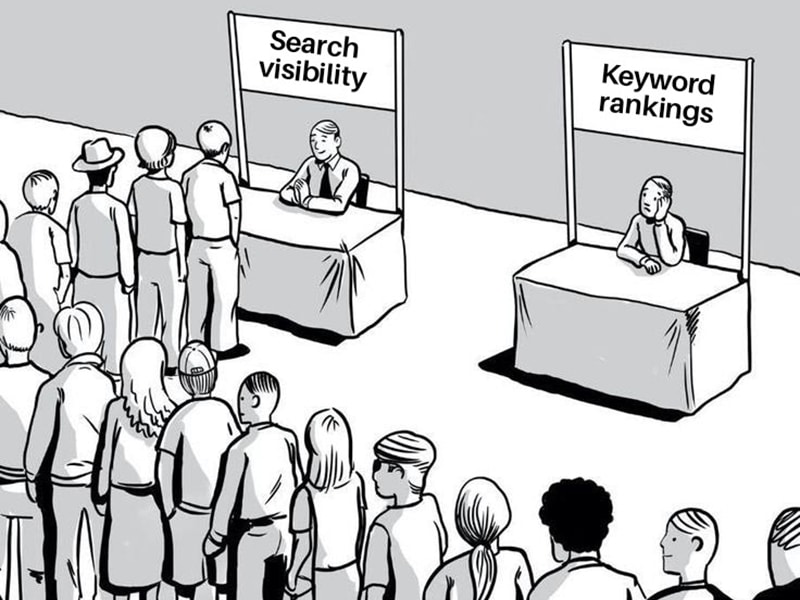
Rankings tell you your position. Search visibility tells you the impact. The difference between those two things is worth understanding clearly.
Rankings without context are misleading
A #1 ranking for a keyword that gets 10 searches per month contributes almost nothing to your organic presence. A #5 ranking for a keyword that gets 50,000 monthly searches contributes far more. If you report to a client or stakeholder that you “rank on page one for 40 keywords,” that sounds impressive, but it says nothing about whether those keywords drive meaningful traffic or whether your site is actually visible where it counts.
Search visibility solves this by weighting each ranking according to the search volume behind it and the click-through rate associated with that position. It shifts the conversation from “where do we rank?” to “how much of the available organic attention are we actually capturing?”
The click-through rate curve changes everything
The relationship between ranking position and clicks is not linear — it’s exponential at the top and nearly flat everywhere else. Studies consistently show that the top three organic results capture between 50% and 70% of all clicks on a given results page. By position five, click-through rates drop to around 5-7%. By position ten, they fall below 3%.
This means that moving from position 5 to position 2 for a single keyword can produce a larger increase in organic traffic than moving 20 keywords from page three to page two. Search visibility accounts for this reality. Raw ranking counts don’t.
Visibility connects SEO to business outcomes
Traffic alone doesn’t tell you whether your SEO strategy is working. You could see traffic increase because of a few seasonal keywords while your core terms are quietly slipping. Search visibility, tracked consistently, reveals whether your organic presence is growing, shrinking, or stagnating across the keyword landscape that actually matters to your business.
When leadership asks “how is SEO going?”, it’s the search visibility score that gives you a more honest, defensible answer than cherry-picked ranking improvements or raw traffic numbers that fluctuate for reasons unrelated to your work.
What Causes Search Visibility to Change
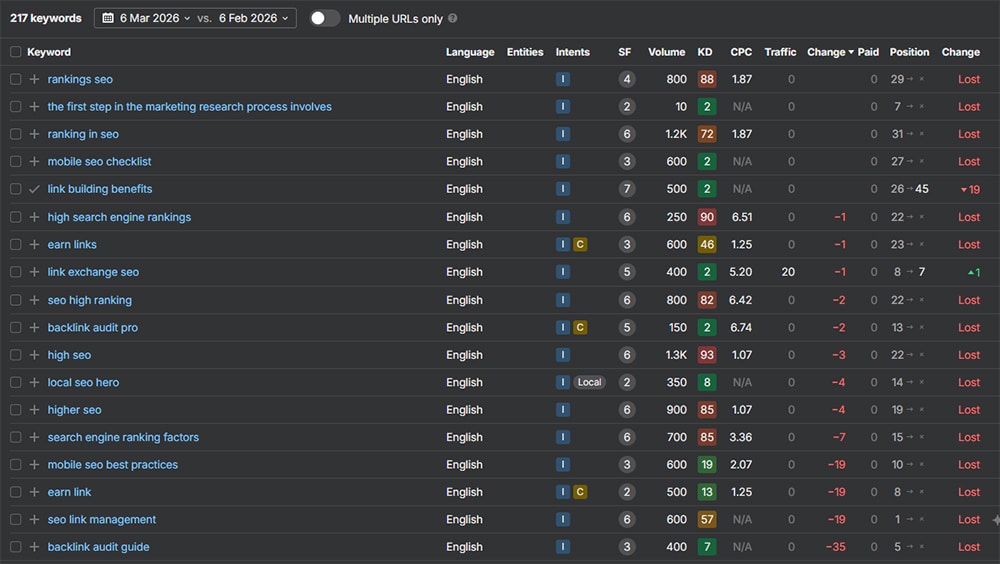
Visibility doesn’t move randomly. Specific, identifiable factors push it up or pull it down, and understanding them helps you respond effectively.
Algorithm updates
Google runs thousands of algorithm changes per year, but the major core updates (typically a few per year) are the ones most likely to produce noticeable visibility shifts. These updates often adjust how Google evaluates content quality, relevance, and authority. A core update might reward sites with stronger topical depth and penalize thin content, causing visibility to shift across entire industries.
When your visibility drops after a confirmed update, resist the urge to make immediate, sweeping changes. Monitor for two to three weeks to see whether the drop stabilizes or reverses. Google’s own guidance is that there may not be anything specific to “fix” — the algorithm is simply recalibrating which content best serves searchers.
Competitor activity
Your search visibility is relative. When a competitor publishes stronger content, earns authoritative backlinks, or restructures their site for better topical coverage, they can displace your rankings without you doing anything wrong. This is especially common in competitive niches where multiple sites are actively investing in SEO.
Tracking competitor visibility alongside your own (which most SEO platforms support) helps you distinguish between “we’re doing something wrong” and “a competitor just got better.” Those two situations require very different responses.
Technical issues
Crawl errors, indexing problems, slow page speed, broken redirects, and mobile usability issues can all silently erode visibility. These problems are particularly damaging because they often don’t produce obvious symptoms until the damage accumulates. A page that Google can’t crawl won’t rank. A page that loads slowly will gradually lose position to faster alternatives.
Regular technical audits catch these issues before they compound. Prioritize anything that affects crawlability and indexation first, since a page that isn’t indexed has zero visibility regardless of how good the content is.
SERP feature changes
Search results pages are no longer just ten blue links. Featured snippets, AI Overviews, People Also Ask boxes, image packs, video carousels, and knowledge panels now occupy significant space above traditional organic listings. When Google introduces or expands a SERP feature for keywords you rank for, your organic visibility can decrease even if your ranking position stays the same — because less attention reaches the standard organic results.
This trend is accelerating. Monitoring which SERP features appear for your target keywords helps you understand whether a visibility drop is caused by your own performance or by changes in how Google presents results.
Content decay
Content that performed well a year ago may not perform well today. Information becomes outdated. Competitors publish newer, more comprehensive alternatives. User expectations evolve. This gradual decline, often called content decay, is one of the most common and least dramatic causes of visibility loss. It doesn’t happen overnight, so it’s easy to miss until the cumulative effect becomes significant.
Auditing your top-performing content on a regular cycle and refreshing it with current information, better structure, and expanded coverage is one of the most reliable ways to defend existing visibility.
How to Improve Your Search Visibility

Improving search visibility means ranking higher for more valuable keywords. That requires coordinated work across content, technical health, and authority, not just one of those in isolation.
1. Prioritize striking distance keywords
The highest-return visibility improvements come from keywords that already rank near the top of results. A keyword at position 8 that moves to position 3 will produce a much larger visibility gain than ten keywords moving from position 40 to position 30. The click-through rate curve makes this math unavoidable.
Filter your tracked keywords to find terms ranking between positions 4 and 15. These “striking distance” keywords are your best candidates for focused optimization because Google already considers your content relevant — it just needs to be pushed higher. Prioritize the ones with the highest search volume, since those move overall visibility the most.
2. Align content with search intent
Search intent alignment is the single biggest factor in whether a page can rank in the top positions. If the top results for a keyword are all long-form comparison guides and your page is a product listing, you’re fighting against what both searchers and Google expect.
For each target keyword, study the top three to five results and pay attention to:
- Format. Is it a blog post, a comparison page, a tool, or a video?
- Depth. How detailed is the content? What subtopics does it cover?
- Angle. What specific perspective or promise does the title make?
Then structure your content to match or exceed that standard. When you see a page stuck on page two despite strong on-page SEO, intent misalignment is often the reason. Rewriting content to match what searchers actually want frequently produces ranking improvements without building a single new link.
3. Build topical authority
Google increasingly evaluates sites based on their depth of coverage across a topic, not just the strength of individual pages. A site that publishes one article about project management will struggle to outrank a site that has 30 interlinked articles covering every aspect of the subject.
Building topical authority means systematically covering the subtopics, questions, and related concepts within your core areas. This creates a content ecosystem where each page supports the others through internal links and shared relevance signals. Over time, this approach makes it easier for every new page you publish within that topic to rank because Google already trusts your site as an authority on the subject.
4. Earn relevant backlinks
External backlinks remain one of the strongest ranking factors. Each link from a relevant, authoritative website acts as a vote of confidence that signals to search engines your content is worth ranking. The emphasis should be on relevance — a link from a topically related site carries more weight than one from a generic domain with no connection to your subject matter.
The Skyscraper method is one proven approach: find competing content that has attracted backlinks, create something meaningfully better, and reach out to the sites that linked to the original. The pitch is straightforward: you’ve built a more current, more useful resource, and linking to it serves their audience better.
5. Strengthen internal linking
Internal linking is entirely within your control and often underused. When you link from a high-authority page to a newer or weaker page, you direct ranking power where it’s needed most. A well-planned internal linking structure distributes authority across your site and helps search engines understand which pages matter most.
Audit your internal links periodically. Look for high-authority pages that aren’t linking out to related content, and for newer pages that have few or no internal links pointing to them. Fixing these gaps is one of the fastest ways to improve visibility for underperforming pages.
6. Optimize for SERP Features
Featured snippets, image packs, AI Overviews, and knowledge panels occupy large portions of the visible results area. Winning one of these placements can increase your search visibility even without holding a traditional #1 organic ranking.
Structure your content with clear headings, concise answer paragraphs, and structured data markup to qualify for these placements. Featured snippets tend to pull from pages that present information in easily extractable formats — short paragraphs that directly answer a question, bulleted lists, or comparison tables. Monitor which SERP features appear for your target keywords and adapt your content format accordingly.
Having a Clear Picture
Search visibility gives you something that individual keyword rankings can’t — a clear, weighted picture of how much of the organic search opportunity you’re actually capturing. It connects SEO performance to business outcomes in a way that raw rankings and traffic numbers on their own do not.
The sites that track their visibility consistently, understand what causes it to shift, and focus their optimization on the highest-impact opportunities are the ones that build durable organic presence over time. Rankings fluctuate. Algorithms change. But a deliberate, informed approach to search visibility compounds in your favor.
Frequently Asked Questions (FAQ)
1. What is search visibility in SEO?
Search visibility describes how prominent your website is in organic search results across a set of keywords. It accounts for both your ranking positions and the search volume behind those keywords, giving you a more complete picture of your organic presence than individual rankings can provide.
2. Why is search visibility more useful than tracking rankings?
Rankings tell you position but not impact. A #1 ranking for a keyword with 10 monthly searches contributes almost nothing to your organic presence, while a #5 ranking for a keyword with 50,000 searches contributes substantially. Search visibility weights rankings by volume and click-through rates, so it reflects actual organic reach.
3. What causes search visibility to drop?
Common causes include Google algorithm updates, increased competition, technical issues like crawl errors or slow page speed, changes in SERP features that push organic results further down the page, and content decay — where previously strong content becomes outdated relative to newer competitor pages.
4. How do I improve search visibility quickly?
The fastest gains come from optimizing “striking distance” keywords — terms where you rank between positions 4 and 15. These already have Google’s recognition as relevant, and moving them higher produces outsized visibility gains due to the steep click-through rate curve at the top of results.
5. Is 100% search visibility possible?
No. Competitors, paid ads, and SERP features all absorb portions of the available clicks. Even the most dominant website in a niche will share organic attention with other results. The practical goal is to maximize your share relative to competitors, not to reach an absolute number.